Thursday, 9 October 2014

Writing With Pictures

There are times in life when you encounter something new and despite a lack of familiarity with the subject matter, you instinctively know that it makes sense. That is how I felt when our lecturer, during a class on Writing for Illustrated Text, introduced the Moebius Codes. The term is drawn from William Moebius's article, 'Introduction to Picture Books' in which he discusses the several ways one may analyse text and images when interpreting the apparent relationship between the text of a picture book and its pictures. The codes are: the code of position, size and diminishing return; the code of perspective; the code of frame and the right and round; the code of line and capillarity; and the code of colour. Each code takes into account the specific elements of the picture and the psychology behind the implied meaning. It was the latter aspect (the manner in which psychology underpins the way readers react/read and engage with pictures) that instinctively made sense to me. This of course is nothing new. 

Most of us are aware of the effects of colours, their emotional connotations, significances and associations. So too would we understand the effects of sizing, framing and perspective on how we assign meaning. Images, regardless of the form they take, will differ in the responses they evoke in the viewer. But to have it so clearly explained, and to have been shown how it can be controlled was especially exciting for me. Here indeed was a means by which to enhance text. This is not to say that pictures take on a supporting role to text, but rather that the dynamics of their interaction with text can create responses in the reader which could not be achieved by text or pictures alone. 

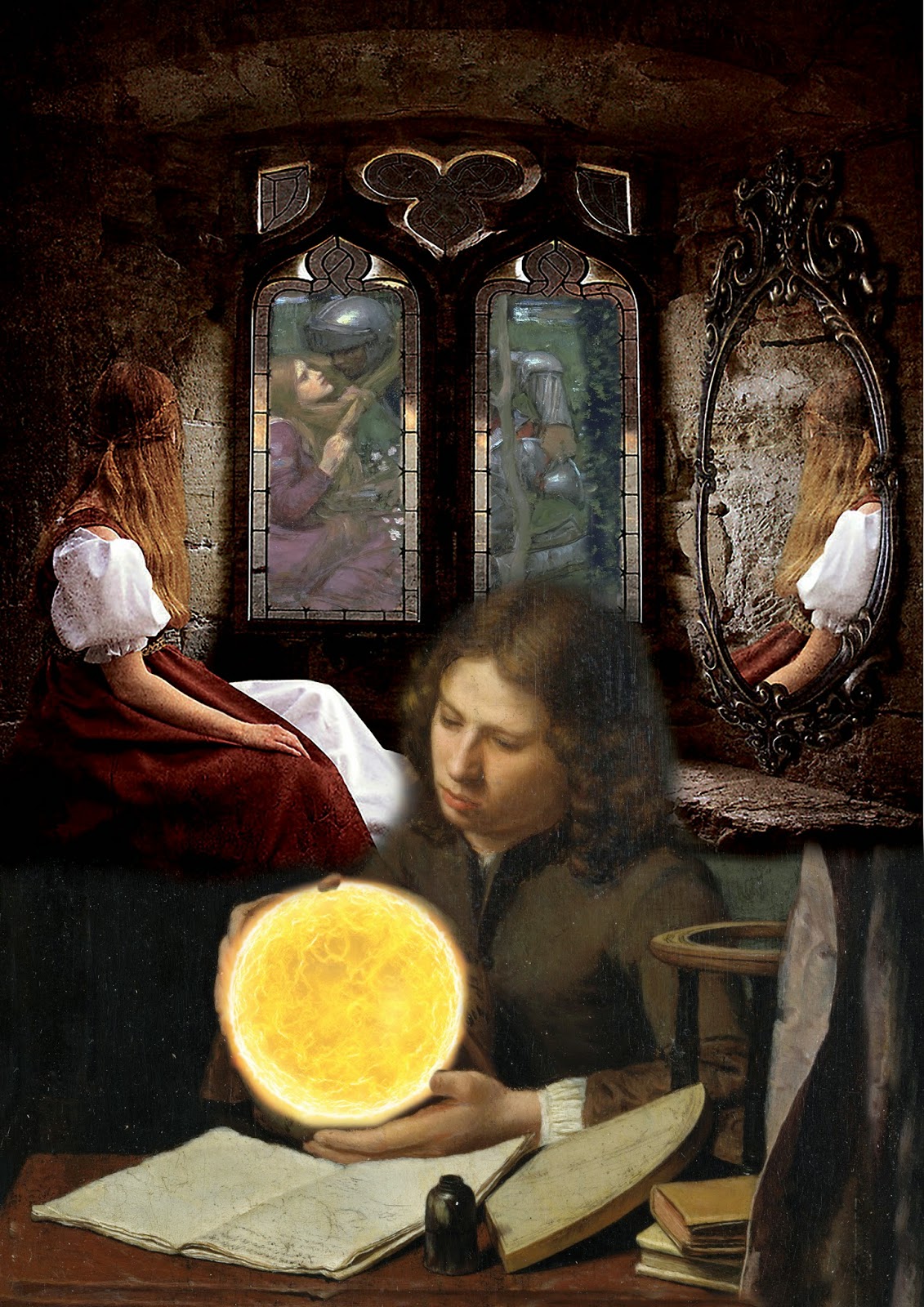
Later, it occurred to me that since I often try to imagine (picture) in my mind's eye what I am attempting to describe in writing, I should instead try drawing on (no pun intended) actual images (photos, illustrations, paintings, photo-shopped compilations and sketches). Thus far, I have only made use of congruent images (another aspect that this subject has made me aware of), but I am starting to realise, even as I am writing these words, that there may be some value in visualising complementary and better still, incongruent images as a means of assisting the creative writing process. Don't ask me to elaborate: at this point it just feels right and that's enough for me to spend time and effort in exploring and experimenting with the notion. I'll keep you informed.


Friday, 12 September 2014

Excerpt from The Edge a fantasy novel by Mary Stephenson.

Orange beaked the seven blackbirds flashed. Against a tapestry of forest green they flew. With wings stretched to full span they shuttled between trees weaving a path through branches and leaves. They cared not for the snapping of twigs, nor too for the dislodging of ancient mosses. Let both tumble to the forest floor. Let both be seen by the villagers below so that they might read the signs and know too that change was afoot.

Long time the blackbirds had waited for this summons. Long time indeed. For more than fifty score years blackbirds had kept sentry over the lands of Chara- biding their time waiting for the moment that The Elder Watch had promised would come. And now with the first sign that a Seeker had finally emerged, the blackbirds had risen from their roosts as if one, paying heed to naught that stood in their path.

Skywards they flew climbing ever higher above the canopy until the reached the thinner air. Each blackbird scanned one of the seven mountains that marked the Edge of their land. Five of the mountains were but shadows in the dimming light. But the sixth and the seventh glowed in the setting sun as if alight with fire. To all who dwelt in the Lands of Chara they were known as the Sister Mountains of the Forest of Teleftera and it was to this forest that the seven messengers turned with haste.

 In near time they reached the Sister Mountains and arrowed their way to the centre of that forest deep. There, above the clearing, the blackbirds circled thrice. Then thrice they swooped and thrice they sang. Their duty done they turned their heads and followed their beaks whence they had come.

In the cottage below, Camhnóir heard the blackbirds’ song and shuffled his feet in time to the tune. And he would have continued to dance, had he not remembered the meaning of their birds’ trilling. Then tapping his temple with a finger crookéd, as if to prompt him of himself, he put down his kettle and took up instead the undertaking of his own task. A task so long ago assigned that barely he remembered it. And, so he took upon his back his coat of green. And upon his head his feathered shawl, for the before-eve air he thought unto himself had turnéd a cooling of sorts. And at that thought, another thought took its time to enter his ancient head. And forgetting the blackbirds’ song, he looked to his hearth. T’would be cold soon and sorely he would regret not stopping now to light a fire to warm him on his return. And what good a fire without a feed? He brightened at the thought and chuckled. A skip and a hop nor more would it take to gather kindling and a log or two. He would stay and enjoy his cup of brew; a bite to eat then when he was warmed and supped he would see to that which he had been bidden to do. He rubbed his hands delighting in a fire that was not yet lit. But where his boots?

If any of the Elder Watch had thought to take this moment to cast their attention on the Forest of Teleftera they would have sent dispatch quick to remind Camhnóir of the urgency at hand but as it was the Elder Watch itself over time had fallen in its vigilance and so, unnoticed and unwatched, Camhnóir continued in his forgetfulness to search for his boots. 

Camhnóir’s toes lead him from the kitchen cold, to the welcome-room of his dwelling. There beneath his greeting-stool his toes sought to find his boots. Big toe touched leather straps and foot drew it forth but when his toes returned to look for the other boot, they chanced instead upon a length of wood. Camhnóir’s mouth formed an O of surprise and to his mind an image came. But needed he to bend and take a look to make sure that what he thought was really so and not the trickery of long-time longing. Creaking on bended knees he stretched out upon the floor. One ear he placed upon the walking boards, not for the listening but to allow for the seeing that one eye could see. Waited he for the grey veil of dim light to pass and then with eyes adjusted to the dark, he espied, asleeping, his long-lost flute, all newly found. His fingers danced a welcoming jig as they did venture forth under the stool taking with them his elbow and his shoulder broad. Then quick as a blink his stretchéd arm plucked back his once lost flute and brought it home to him. Ah, the joy of lost and found.

To his breast he held it first and then he kissed it with his heart. Then rested it he, against his cheek and caressed it with his breath, waking it from sleep. His fingers nimble, his fingers quick he played the notes of his land and in their song he delved as if in dream or under spell. Gone from his ears the blackbirds’ warning, gone from his care the fire burning, gone from his mind the quest awaiting. Camhnóir, the Keeper of Teleftera played on.

Five mountains west from where Camhnóir played, a lone traveller heard his flute atrilling. Moilinth stayed her foot mid step and left it hovering for fear of crackling twig or leaf. She listened with cocked head and turned ear to far and near. The trilling was of a gentle sort. A lilting song full of love and glee, but e’en so Moilinth looked to good side and bad then to abovehead and atfoot. No sign of danger did she see, but mindful of evil and cunning ways, gently she lowered her foot. With steps as soft as feet of bare she left the woodland path and slipped amongst the trees. A curtain of willow she found and behind it down she lay upon the ground. She hastened to make a cover of leaves to hide her skirts, her coat and shawl. To the grass she turned her face and a rock made she of her back. If from the path, some being or creature should pass, she would appear as if of the forest floor. She slowed her breathing and to the wind she turned her ear. 
       
The tune was of a sort she had not heard before, but in it she did discern some ancient notes that were familiar to her ear. The music, pleasant to her senses, was soothing to her grief, lulling her into thoughtfulness of times when happier she had been. With each note the fear that had held her body tight began to disappear. And by and by with heavy eyes thought she now of how it came to be that she was here — ‘neath willow tree in forest deep acomforted with song so fair, from a player she could not see.


Excerpt from The Edge a fantasy novel by Mary Stephenson.

Tuesday, 5 August 2014

A Tall Glass Of Blue

Imagine you are stretched out under the sun at the beach on a hot day. As the sun beats down and warms your skin your face begins to burn. Your face is turning from the colour of cool water to the colour of a burning fire. This colour sometimes comes to your face when you feel embarrassed or excited. It is the colour of warm blood. This colour of blood and fire looks as it feels, intense, full of life, vibrant and energetic yet full of potential danger.


This colour is your heart racing and the heightening of your senses. It is the colour of lust, passion, voluptuous lips, rich strawberries, plump cherries, fragrant velvet roses and sexual desire. But it is also the colour of anger, of energy, adrenalin, action, aggression, speed, and of violence. The opposite of feeling this colour is to feel cold, calm and quiet.

This colour is of summer and of being in the prime of one’s life. It evokes images of vitality and strength and dominates all other colours and is the first to capture attention. This colour can never be overlooked or mistaken. It is bold and confident. It stands out, is easily noticed and hard to ignore. It is the colour that makes you alert and attentive. This is why it is used on fire engines and on traffic stop signs.


If this colour were a time of day it would be noon when the sun is at it highest peak. If it were to be an animal- a lion; car -it would be a Ferrari or a Lamborghini; a spacecraft -it would be a rocket and a type of food-it would be a hot chilli pepper.


If you were to live your life completely in this colour you would feel exhausted because this colour never sleeps, never relaxes, never slows down and never pauses for breath. There is no downtime for this colour. I’m tired just thinking about this colour. I think I need a tall glass of cool blue.

Thursday, 31 July 2014

Communication Breakdown

http://textually.org/textually/archives/2006/06/012721.htm 
Developments in communication technology such as mobile smart phones, the Internet, projectors, digital displays and computing devices have helped create communication platforms, channels and methods by which to reach larger audiences.

            Communication technology is advancing so rapidly that what was once deemed possible only in the realm of science fiction and comic books - just a few decades earlier - is now a reality manifested in the form of 3D projection technology, augmented realities, advanced applications of touch screen technology and, even more astonishingly, thought controlled and brain computer interfaces. Common to all these communication technologies are elements of brevity, speed, ease and immediacy.
             A well-used adage in psychology states that the best predictor of future behaviour is present and past behaviour. If we apply such reasoning to communication technology and its use of pictures, memes, pins, captions, video clips, graphics, and photos then we may conclude that it is highly likely that communication technology in the future will continue to advance to the point where a new global digital literacy will evolve. The digital literacy will carry breadth and depth of meaning, references, connotations, relevance and application in easily recognisable formats (perhaps something akin to hieroglyphics or characters). The literacy will be presented in readily transferable formats allowing for instant recognition, comprehension, replication, disposal or transference across the globe. The recognisable formats will be such that they will cross all cultural, physical and language boundaries thus enhancing communication on a global level.
              The global digital literacy would not only lend itself to visual applications but also to thought and brain applications where verbosity and lack of clarity may prove to be counterproductive. This is not to say that words and language structures as we know them today will change beyond recognition but that a new literacy will overlay existing literacies that may in turn undergo modification into new formats so as to allow even greater accommodation of the demands of future communication technologies. Apart from commercial considerations and the like, there are obvious social benefits to be gained from a global digital literacy. However, I must add a word of caution, (no pun intended). It is important to remember that as such communication increases on one level, so too, on another level, may the degree of alienation and isolation.
            Last semester I witnessed a cafeteria full of students, most of whom were engaged with a digital device of some kind. Students without a device were staring into space reluctant to impose on those engrossed by their devices. The odd thing about the scene was the silence and stillness. Nobody spoke, nobody moved, no body made eye contact. I likened the scene to that of a funeral. The quiet and stillness was reminiscent of the gloom that engulfs us when somebody or something has died.............
That photo? The caption reads, 'By wearing the mobile phone scarf, you can venture into public spaces confident that if the need to compose a private text message were to arise the object could be pulled over the face to create an isolated environment.' 

Saturday, 26 July 2014

When Written Instructions Fail.

They say a picture tells a thousand words. I guess a video clip tells even more. I am a lover of words. Words are powerful but I have to admit that there are times when words fail especially when giving instructions. Such was the exercise put to my Publishing class earlier this week. In 300 words we were asked to write an instructional piece on a task for someone who had never performed it before. I chose ironing a shirt. Growing up my mother insisted that I learn to iron properly and that included ironing all the seams flat before tackling the rest of the garment. Being an expert and a practised hand at ironing I thought the exercise would be a breeze but it proved to be more difficult than anticipated. The main difficulty was in finding the precise terminology to describe different aspects and actions.  What follows is my feeble attempt. Some things are best demonstrated visually.

How To Iron A Shirt

Materials/Equipment
·      An Iron. Preferably the iron should have steam and power shot settings.
·      An Ironing Board
·      Spray Bottle
·      Water. Normal tap water is suitable for most irons but some irons require distilled water. Distilled water is readily available in most supermarkets.

Preparation
·      Make sure the iron’s surface is clean.
·      Fill the iron with water to the recommended level as indicated on the iron.

Method Steps
1          Read the shirt’s label and set the iron to the recommended heat level. 
2          Turn the shirt inside out.
3          Mist spray the shirt. If the shirt is slightly damp, it will be easier to iron.
4          Iron the collar first. Start with the underside, pressing from one edge to the middle and then from the middle to the other edge. Turn the collar over and repeat the process on the other side.
5          Iron the cuffs. Unbutton it first and lay it flat. Iron from the inside then the outside, moving all wrinkles to the edge of the fabric. Iron around not over buttons.
6          Iron the shirtfront as separate halves. Start with the side that has buttons. Iron around the buttons. Then iron from the shoulder to the bottom edge. Repeat on the other side.
7          Iron the back of the shirt. Lay the shirt flat so that one half is overhanging. Start at the      back shoulder area and work down. Slide the other half onto the board and repeat.
8          Iron the sleeves. Make the fabric on both sides of the sleeve is flat before you press the  iron down. To do this line up the seams. Turn the sleeve other and repeat. Move now to               the next sleeve.
9          Hang the shirt on a clothes hanger and let air and cool before placing in wardrobe.